Even as the crowd at Gates Restaurant and Bar roared in approval and support of local band Rock Paper Soul on Saturday night, their noise level pushing the group into the final round of the fourth annual “Battle of the Bands” competition, the group seemed unperturbed. It was as if they had completed just another rehearsal at a member’s home, rather than an hourlong set in front of a raucous, standing-room-only crowd.
That cool and calm attitude was not an act, but rather a microcosm of the general tenor of Rock Paper Soul, a group whose joy comes from playing the music that they love, with the people that they love. Being showered with love from an audience is certainly nice, but it is not why Dana Gordon and her bandmates formed their group in 2017.
“…Covering the best music from the 60s to today with people I deeply care about, respect, have a blast with, and love was why I wanted to form this band” says Dana, the founder, co-lead vocalist, keyboardist and manager of Rock Paper Soul says.
Rock Paper Soul is a group that covers soul and classic rock from the 60’s and 70’s, playing over 25 gigs in 2022 across Fairfield County, Connecticut. They say that since first forming their group, they now have “50-plus” songs in their repertoire. On Saturday night alone they covered Queen, Guns N’ Roses, Aerosmith, and many more different groups.
“The timelessness of those genres, the beauty of the lyrics, the emotional impact of the unforgettable melodies are what underscore the love of covering songs from those eras,” Dana explains.
“Personally, I love so many types of music. Soul speaks to me specifically through melodies and harmonies; classic rock brings a great energy into the mix,” says fellow co-lead vocalist Caroline.
Their choice of music blend was received well enough to move them past Alter Ego Band into the final heat of the “Battle of the Bands” competition, next Saturday, February 4. The final heat will be the only one in which admission tickets are sold, with the proceeds going directly to New Canaan Meals on Wheels.
One may wonder what the level of competitiveness is like between Rock Paper Soul and the other bands competing in the contest. According to the band, who first met each other and consequently other local bands in the adult program at the New Canaan School of Rock, there’s more to the “battle” than simple competition.
“We like seeing what everyone else is up to – it’s competitive in one way but not in another; we each have our own niches and there are lots of opportunities for everyone,” Caroline explains, “generally speaking, we tend to support each other, going to each other’s shows…many of us still play together there [New Canaan School of Rock].”
It was at the New Canaan School of Rock that Dana first met Caroline and the band’s drummer Rob, more than seven years ago. In 2017, Dana learned about the Greenwich Town Party, a yearly event held in Greenwich, Connecticut that attracts world famous artists such as James Taylor, Paul Simon and, most recently, Billy Joel. The event also chooses five local bands every year to play as openers for that year’s heavy hitters. It was this opportunity that inspired Dana.
“I reached out to Rob, Caroline, and several other friends in the adult program to ask if they wanted to form a band for the express purpose of trying to get selected to be one of the 5 local bands chosen…although we didn’t get selected that year, we had such a great time forming our own band that we wanted to continue with it.”
The love and passion that began to be forged for the purpose of playing that specific event has persisted ever since, as various other band members came and went, and the COVID-19 pandemic forced the band to adapt in ways they had never imagined.
“Covid definitely didn’t help. We had to be very creative with outdoor practices and very spread-out open practices for people to come and listen to us,” Dana recalls.
That persistence has paid off, as evidenced by the following that the band has accumulated in the area, which was out in full force on Saturday night. Throughout the performance, clearly devoted fans danced along to songs played by the band, and even took the time in between songs to scream out their affection for Dana and the band. Such treatment is usually reserved for bands of global fame and prestige, but to know Rock Paper Soul, and to have witnessed their performance on Saturday night, adulation of this sort was more than warranted.
In the wake of the COVID-19 pandemic, there has been no shortage of discourse about the ways that society as we know it has been irreparably altered. Most of this has dealt with matters in the adult world, but what about the ways that the lives of America’s youth have been altered? One particularly informative way to assess what has changed is through the lens of youth sports in the United States.
An investigation into that youth sports system revealed deep fragmentation, plagued by a decline in participation rates, socioeconomic stratification, and a full-blown mental health crisis. As was the case in many other parts of society, the COVID-19 pandemic simultaneously exacerbated already existing issues that had (for years) gone unaddressed and created new problems as well. Given the abundance of problems we face in our time, it is not a surprise that issues in the world of youth sports would be relegated to the societal periphery. However, issues currently being faced by our young people in the short term will have wide ranging long-term effects. Given the way in which sports have often served as a reflection of the health and vitality of our democratic society, we must take constructive steps to address these challenges head-on.
I: Participation Trends: Who Got Left Behind?
In the spring of 2020, COVID-19 brought the entire world to a screeching halt. Businesses closed (some permanently), schools sent students home and attempted to soldier on in the newfound world of Zoom, and professional and collegiate sports paused their seasons or cancelled them entirely. In a time where an invisible disease which wrought illness and death seemingly lingered around every corner, no part of society was spared from mitigation efforts. Though much of the world has returned to some semblance of pre-pandemic normalcy, participation and engagement in youth sports across the board have had a more difficult time rebounding.
“I think the biggest issue is in the months and years lost, with no contact and playing sports. Children lost the ability to practice and or just play at all. Now, in observing in our programs the levels at which children should be participating, they fall short,” says Andrea Russo, the head of the Department of Recreation in Pound Ridge, New York.
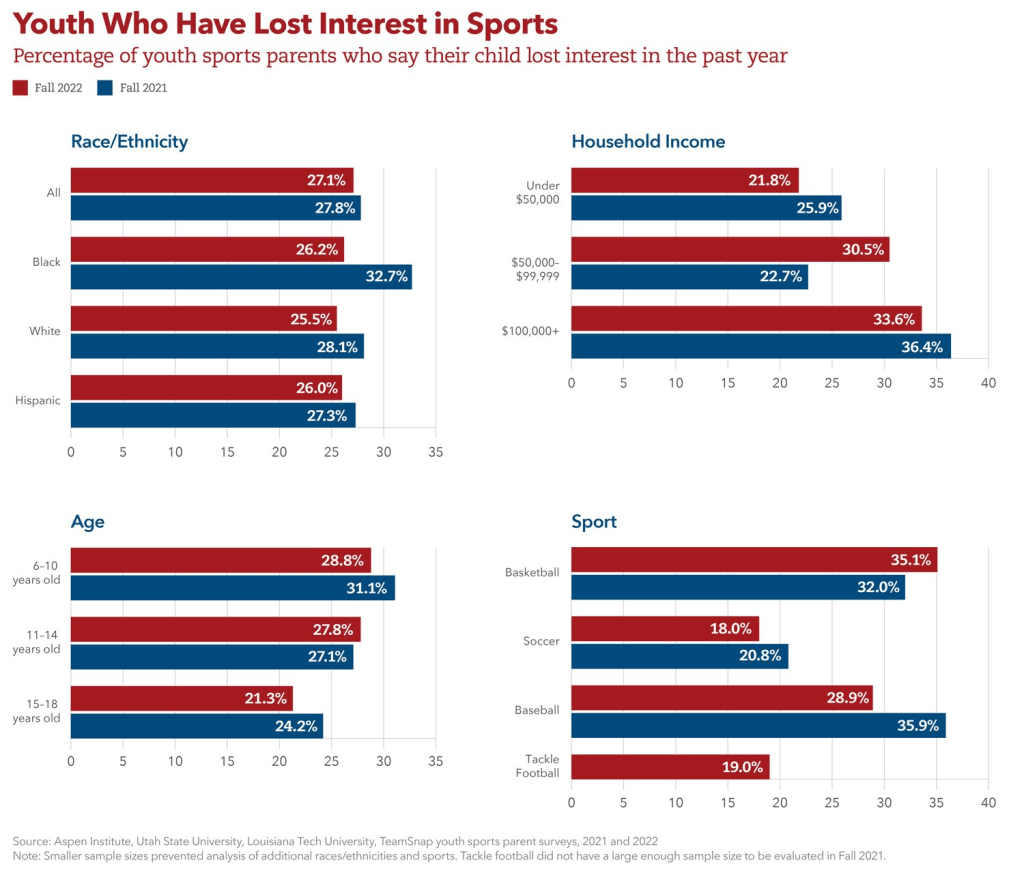
Indeed, the Aspen Institute found that, in 2022, youth participation in team sports remained at a “historically low” level. For some children, the absence of athletic commitments during COVID was something of a liberating experience, and they decided that they were better off without organized sports in their lives. The rate at which these children have lost interest in playing sports in the past two years is startling. This is reflected in the graphic below, courtesy of the Aspen Institute:
“Prior to the pandemic, our middle school sports programs had been struggling for years, and COVID only made things worse. We basically lost a full year of athletic growth for most of our students as they were locked down in their homes,” says Joe DiMauro Jr., a middle school physical education instruction in Bedford, New York, “very few kids were able to maintain the same level of sport participation throughout the pandemic. Now, many students feel they are behind athletically and are not comfortable starting back up and joining our modified school teams.”
This is where it is important to discuss the impact of technology in this participatory equation. While some children, particularly those in neighborhoods with significant amounts of green space outdoors and where crime was not a concern, were able to maintain some level of meaningful physical activity, others only had technology to turn to. It is not a secret that the ever-increasing prominence of video games and social media have contributed to declining rates of participation in youth sports, or general engagement in physical activities.
“Organized youth sports have never done the research that they need to do to draw kids in and keep them in. Social media and phone games run tests, do their homework and have algorithms that keep kids engaged. We’ve never talked to kids about what changes they’d like to see in their sports, or what sports they want to play. The videogame people have that mastered,” says Dr. Jay Coakley, a sociologist who specializes in youth sports.
Figuring out how to counter the effects of these technologies will be crucial in the effort to bring children back into organized sports. Likewise, much thought and consideration will need to be devoted to the broader question of why more kids are losing interest in organized sports in general. Participation rates were in gradual decline prior to COVID, and though they are beginning to bounce back, this should still be cause for concern.
Aside from the desire of children themselves to participate in organized sports, one question that must be answered is whether there are even enough adequate and affordable opportunities available to them in the first place.
II: Socioeconomic Stratification: The Have’s and The Have Not’s
As was the case in virtually every aspect of the COVID-19 pandemic, wealth and socioeconomic status were major factors in terms of who felt the worst effects of the pandemic, and who was able to weather the storm. Youth sports were no different in this regard. Well-endowed, privately paid for programs were able to stay afloat and even prosper, while programs funded by public money suffered tremendously.
“During the pandemic, some families that had money could continue playing sports. They traveled to different states to play in tournaments if their state had sports shutdowns. Lower-income families could not do that,” says Jon Soloman, editorial director of the Sports & Society Program at the Aspen Institute.
“Pay to play programs became even more dominant during and after COVID, and right now, many of those recreation programs that didn’t have consistent funding and the support of major organizations, have had a hard time getting back together,” says Dr. Coakley, “COVID accentuated the division between the high cost pay to play programs and the low-cost recreation programs.”
The youth sport programs that have been most harmed by this trend are the ones that are administered through local parks and recreation departments. They are often funded by tax-payer money and administered by parents and other adults in the community willing to volunteer their time and services. Such programs have been especially important in lower-income communities because the only “barriers” to participation are modest registration fees, and the cost of the necessary equipment to participate.
Sometime in recent years, the prevailing sentiment began to view such programs as a less efficient means of allowing children (and their parents) to achieve various goals in athletics, such as receiving a college scholarship to play their respective sport. Parents have been incentivized to believe that the more money that they put into their child’s athletics, the more that they will get out of it on the back end. While this segmentation has benefitted those able to afford it, it has also had the effect of “pricing out” countless families who simply cannot afford the costs of travel, registration, training, etc. Post-COVID inflation has only made participating in such programs less attainable for more families.
According to the Aspen Institute, in their annual “State of Play” report for 2022, families who have a household income of $150,000 or more spend nearly four times the amount of money on one child’s primary sport (per season) than families making less than $50,000 dollars. These economic disparities can also be observed along racial lines, as white families spend $300 more on one child’s primary sport (per season) than black families. Simply put, youth sports have increasingly become a system whereby the “elites” can insulate themselves from those families with less money and have created a “pay for play” system that is seen as more desirable, and largely self-sustaining.
“Local programs used to be funded publicly through parks and recreation departments, all through tax money. The cost per player was minimal, if not free. I don’t see those coming back, unless there is a major political change in the United States. The people who are relatively wealthy have created programs that reflect their own interests, and they are not going to leave those programs,” says Dr. Coakley.
III: The Pandemic and Youth Mental Health: Children Are Struggling
Aside from the pure physical toll of the COVID-19 pandemic, perhaps the most destructive effects on young people and the public at large can be seen in mental health. As has often been the case, the pandemic exacerbated already existing problems in the mental health of children and young people, creating a full-blown crisis (as indicated by the CDC):
Such findings have been far from limited to the CDC, as the National Institute of Health last year concluded that,
“The impact of the COVID-19 pandemic on mental health of children and adolescents is multifaceted and substantial. Survey studies regarding child and adolescent mental health amid COVID-19 indicated that anxiety, depression, loneliness, stress, and tension are the most observed symptoms.”
The lack of availability of organized sports during the pandemic contributed to these alarming trends. For many children, organized sports serve not only as a means of socialization with other children, but also as a means of exploring identity. Organized sports offer life lessons to children about the importance of teamwork, sportsmanship and accountability. Though such lessons can be replicated in other kinds of activities, very few offer them in tandem the way that sports do. Another, perhaps lesser explored benefit of participation in organized sports is in the ways that it benefits the relationships built between children and adults:
“One thing that is so key that sports provide is that there is a community of caring adults around them who will support them in all contexts. Adults become important caregivers to kids, and during COVID, their circle of caring adults became much more constrained,” says Maryam Abdullah, a child psychologist for the Greater Good Science Center, “[in not] learning that there are other trusted adults in the community, that was a lost opportunity for children who were deprived of opportunities to participate in sports.”
Organized sports also, for many children, serve as a means of escape from problems that may be plaguing their home life. The pandemic served as the first time that a lot of children had to deal with feelings of profound grief. Some lost family members, others had parents who lost jobs and whose stress and anxieties permeated their children’s lives, and others still were faced for the first time with real-world issues that were simply inescapable. Children were faced with a situation where they had nowhere to turn to alleviate their stresses and feelings, and that has shown.
As children have returned to playing fields across the country, there has been a greater impetus on coaches and administrators to be more nurturing to the needs of children.
“If sports aren’t delivered properly, such as coaches or parents not making the experience fun and applying too much pressure on youth, this can hurt the already fragile mental health for some youth. Too many children don’t see sports as a place for them. They don’t feel welcome, they don’t believe they’re good enough to play, and in some cases, sports can be a toxic culture. That has to change,” says Jon Soloman, “coaches can play a significant role by better understanding how they communicate with athletes can make a difference, including providing safe spaces for youth to feel like they can talk about their problems.”
“Coaches are in a position to observe any changes in children’s behaviors that could be signs of something that they can explore further. It’s important for coaches to be on the lookout for signs in children and have a conversation with them, to show them that they care,” says Maryam Abdullah.
This paradigm shift in what is required from coaches and adults in their relationships with young athletes is not something that can or will happen overnight. It is going to require a systematic restructuring of the ways in which coaches are taught and trained to be coaches. No longer can the focus simply be on X’s and O’s and how to win games. Far more important than the win-loss records are the mental wellbeing of the children who are participating in organized sports.
“Young people have greater mental health needs now than they did prior to COVID. But it’s not just COVID, it’s the uncertainty that they see regarding their own futures (climate, crime, ability to buy a house, ability to get into a good school, etc.),” says Dr. Coakley, “any parent would buy into a program that said, ‘we’re going to be sensitive to your children as human beings, and we’re going to treat them as human beings, rather than little machines to benefit us as coaches.’”
IV: What Does This All Mean?
When viewed in totality, the picture of youth sports in the United States, in the wake of the COVID-19 pandemic, is one of uncertainty.
Though there is evidence that participation levels are returning to where they were prior to the pandemic, coaches and administrators alike will still have to find a way to reengage those children who either lost interest in organized sports or those who suffer from a lack of confidence after such time away from sports. It is up to these administrators, particularly those working in recreation departments across the country, to look at what today’s kids find interesting and engaging generally and find a way to implement that into their sports. Children today have seemingly unlimited options to occupy their attention, so it needs to be impressed upon them that a healthy and constructive way to do so is through participation in organized sports.
This effort, particularly on the part of local communities, is likewise perhaps the only plausible way to try to counteract the movement towards a youth sport structure that is highly segmented and exclusive. Sure, the “pay for play” system benefits those who can afford it, but what about those who cannot? Are we supposed to simply accept a future when all college scholarships are doled out to the children of the 1%? There must be a concerted effort from the top-down to prioritize, fund, and advertise local sports programs that are publicly funded. There is a massive pool of children out there with the skills and drive to participate and excel in sports, but there need to be ample opportunities for them to do.
In terms of adjusting the youth sports structure for an era in which children’s mental health is finally receiving the recognition and prioritization that it deserves, much of that responsibility will fall to parents and coaches. Organized sports offer such an abundance of not only physical, but also psychological benefits for children and young people…if they are administered correctly. All children should be made to feel that their local organized sports are accepting and empowering, allowing them to learn important life lessons, allow them to learn more about their respective identities, and allow them to further their process of socialization.
Likewise, the way that coaches are trained, and the responsibility that they must be willing to take on, must also be adjusted. Coaches are in a unique position to serve as sounding boards for children, especially those who may not feel comfortable discussing their mental health struggles with their own parents. Coaches are not psychologists, but they must be at least trained to show children that they care about them, and that their athletic experience is about much more than wins and losses.
The COVID-19 pandemic should have served as a wake-up call for all the things that are wrong or need to be corrected in the American youth sports system. Whether or not the adults involved have received the message, will be everything in determining what exactly the future of youth sports, and therefore the future of America’s youth, looks like.
Xavier Kistoo-Miles is a 6’3’’ shooting guard for Manhattanville College who has always had a desire to help people. This desire, evident from an early age, has guided him throughout his life. It guided him through adolescent years spent as a volunteer firefighter, and it guided him first to the University of New Haven, then to Rockland Community College, then finally to Manhattanville College, a school with a talented basketball team and a renowned nursing program. Now, heading into his senior year, this desire will guide him to a (slight) change in his major, from nursing to radiologic technology.
Such a pivot will mean a continuation of the extensive workload that accompanies any major in any medical field, along with long hours spent in hospitals for clinicals. Academic workloads such as this can be hard to manage in and of themselves but, when coupled with being a high-level Division III athlete (which can be like having a full-time job), they can seem overwhelming to outside observers. Xavier, however, takes it all in stride.
“It is a lot like nursing in terms of [having] clinicals, going to hospitals. It’s going to be difficult, but I think I am going to be able to get through it…education comes first,” he says.
Xavier Kistoo-Miles grew up in Spring Valley, New York, a town of 33,000, about 22 miles north of Manhattan. He grew up in a household headed by parents who are both still nurses, so he has been around nurses and hospitals his entire life. He is somebody who has seen the highs and the lows that are part of the daily life of being in the medical profession. After briefly switching his major to sports studies for the second semester of his junior year, these experiences that he has borne witness to influenced his thinking about his major:
“I was thinking about going back into nursing, but ultimately decided to go with RadTech (Radiologic Technology) instead,” he continues, “I do like helping people, but I’ve seen a lot of the stress that my mom has working in a hospital, especially during COVID…she was overworked a lot.”
A decision of whether to switch one’s major is an important one that weighs heavily on the mind of any college student, athlete or otherwise. For Xavier, however, he had the additional burden of recently being diagnosed with Rhabdomyolysis, often called “rhabdo,” for short. This rare, treatable condition is one that the CDC describes the following way:
“…when damaged muscle tissue releases its proteins and electrolytes into the blood. These substances can damage the heart and kidneys and cause permanent disability or even death.”
It is a condition that afflicts less than 200,000 people per year and can be caused by an injury gone wrong, or simply by overexercising, according to the Mayo Clinic. Xavier believes that his case was caused by the latter, perhaps a time or two too many of intensive weightlifting and conditioning, followed by hours of putting up shots in the gym.
Since he got diagnosed, just prior to leaving for North Carolina—where his family now resides—for the summer, Xavier hasn’t been able to get started on the basketball team’s offseason conditioning program, but he is feeling better and hopes that another round of bloodwork will reveal that he is past it.
Once that is the case, it will be full steam ahead for the rising senior. He seems to have a particular itch to get back in the lab and work on his game following a junior season that ended in a way that left him with a bitter taste. Though the Valiants finished the year with an impressive 21-8 record and Xavier put up solid averages, the season ended with two bitter losses to Farmingdale State College and Neumann University by six and seven points, respectively. In that final game against Neumann, Xavier had perhaps his finest performance of the season, leading his team in scoring with 16 points on 11 shots, including going 4-7 from three-point range.
However, it is his team’s loss to number-one-seeded Farmingdale in the Skyline Conference Championship game that has stuck with Xavier. In the penultimate game of the season, Xavier didn’t play to his usual standards on offense, though he did have a solid defensive game, registering two blocks. This outcome still bothers him.
“I froze up a little bit,” he recalls, “coming into the next season, I know what to do and I’ll be better prepared. I hope to get back to that stage and I hope it’s against them…I want that rematch.”
As a player, he describes himself as cerebral, looking to get the defense into mismatches and break down his defender, though he notes that he also derives great joy out of dishing the ball to his teammates and putting them in positions to be successful. This unselfish, thinking man’s approach to basketball makes perfect sense when considered in the larger context of what he hopes to do when his time at Manhattanville comes to a close.
He hopes to find a job, ideally as a nurse or as a radiologist, where he can be both financially stable and happy in his profession.
“My future [hopefully] comes with a lot of money…and is hopefully something in radiology. My original plan was to become a nurse-practitioner and eventually a travelling-nurse, but I’ve got to see where radiology takes me,” he says.
Wherever that path takes him, whether it be to a career as a radiologist, or back into the nursing profession (which would require additional schooling beyond his undergraduate work) he knows that he’s made great connections and great friends during his time at Manhattanville and elsewhere. He hopes that he maintains those relationships and connections throughout his life, regardless of where his career ultimately ends up.
For now though, Xavier Kistoo-Miles enters his senior year at Manhattanville with two distinct goals: to graduate with a degree in radiologic technology and for his team to win the Skyline Conference for the second time in their history. To know Xavier—his story, his demeanor and his work ethic—is to know that these goals, and far more, are certainly within reach.




 James Peacock's Website