By James Peacock

Native American Wigwam. Trailside Museum, Ward Pound Ridge Reservation.
Understanding history is not a solitary affair. To have a basic knowledge of history is one thing, but a true understanding of that history is gained through conversations, oftentimes hard ones. Jon Scott Bennett understands that, and it is why he decided to make his documentary, “The Pound Ridge Massacre: A Dark Chapter for Early America” (2021).
As the title suggests, Jon Scott Bennett’s documentary explores a grim episode of violence waged against Native American populations by European colonists in the centuries following their first voyages across the Atlantic. Being just one of countless atrocities committed against Native Americans, “The Pound Ridge Massacre” does not carry the same level of notoriety as other instances of violence, such as the “Jamestown Massacre” or the “Wounded Knee Massacre.” That is exactly what led Jon to his discovery of the tragic events in the first place.
“I’ve been a history buff my whole life,” Jon said, “one day I started Wikipedia searching about the early colonial history of New York, and a series of hyperlinks led me to ‘The Pound Ridge Massacre;’ I have been to Ward Pound Ridge Reservation many times, my parents were scout leaders there, and I thought: ‘that can’t be the same Pound Ridge.’”
This Wikipedia page, scarcer then than it is now, told the story of a terrible evening in March 1644, in the decisive battle of “Kieft’s War” between Dutch Colonists, led by Captain John Underhill, and the Wappinger Confederacy. On that fateful night, an estimated “500-700” men, women and children of the Wappinger were shot or burned alive by the Dutch force, effectively ending Kieft’s War. A single account, from somebody who was there, of that night was written by an anonymous Dutch colonist in 1647 and, according to Jon Scott Bennett, “was missing a lot of information.”
There has been very little commentary on the incident across mainstream literary and journalistic channels, the most notable of which came in Tina Kelley’s 2004 piece “In Their Footsteps,” which was published in the New York Times. In her piece, which delves into the ways in which the presence of Native Americans is still felt across the entirety of Westchester County, Tina briefly notes:
“Dutch soldiers under John Underhill attacked what some scholars believe to be the southern end of Indian Hill Road, near the junction of roads from Bedford to Stamford [Connecticut] and Pound Ridge… killing more than 500 people, including women and children, who, the Dutch noted, did not cry or scream” (Kelley, 2004).
Though not quite among the mainstream himself as an aspiring documentary filmmaker, Jon decided that he was going to try to “fill in the gaps” on this horrific incident.
Jon then spent the ensuing months traveling across Westchester County and parts of Connecticut, visiting libraries, museums, and historical sites, coming across many books and articles that helped to fill in the pieces of the puzzle. He notes that the Pound Ridge Historical Society and the Ward Pound Ridge Trailside Museum were receptive and helpful to him, however most of the information that he gathered for his documentary came from literature:
“Most of, if not all the info was from books,” Jon said, “The real difficulty was trying to figure out which sources were reliable, how to deal with contradictory information from different accounts. The whole thing felt like an ‘Indiana Jones’ trip. Every element was a new discovery of some sort.”
After all that research, Jon did finally complete and publish the film on Christmas Day of 2021. The film has now been viewed nearly 2,000 times on YouTube alone, accompanied by a series of positive comments from viewers, many of whom either used to, or currently live in the areas of Westchester County highlighted in the documentary. Jon also has held live in-person and virtual screenings of his documentary all over Westchester County and finds it to have been received very positively.
“A lot of people have this expression of disbelief to have not known about it. Like, ‘how have we never been told about this incident?’ A lot of people also take interest in the last section of the film, trying to figure out where it actually took place, seeing if it was somewhere close to home for them,” Jon said.
That last section of the film, in which Jon tries to use the various context clues from his research to pinpoint the exact location of the massacre, is perhaps the most polarizing aspect of the massacre. Based on how little anecdotal information there is from that time, and that towns like Pound Ridge were not even officially formed yet, it is difficult to deduce whether the incident took place in modern-day Pound Ridge, or somewhere in one of the neighboring towns.
For this reason, Jon acknowledges that he is “not 100% sure,” whether the massacre took place in Pound Ridge, or elsewhere. Additionally he acknowledges that, collectively, we may never know for sure if it took place in Pound Ridge or not. However, he does say that based on his research, he believes the massacre to have taken place somewhere on or around modern-day Indian Hill Road, on the border of Bedford and Pound Ridge.
This is one aspect of the “Pound Ridge Massacre” where Jon notably differs from others in the local intellectual community who have also studied the massacre. Deborah Benjamin, President of the Pound Ridge Historical Society, has this to say when asked if the massacre really took place in Pound Ridge:
“…What we know about the event is extremely limited. It is based upon a single account by a Dutch colonist who provided their account three years after the event took place. Their description provides very few details, including an exact location for the incident. The event might have occurred in what is now Pound Ridge, or it might have occurred somewhere nearby. We simply do not know. While the incident is commonly referred to as the ‘Pound Ridge Massacre,’ this name might be misleading. The first recorded use of the name ‘Pound Ridge’ is said to have occurred over 90 years after the event took place.”
Another differing perspective comes from Maureen Koehl, the Town Historian for Lewisboro, a town neighboring Pound Ridge. She has not viewed Jon’s documentary, but has studied the history of Indigenous peoples in the area for more than 30 years.
“All things considered, the Woods Bridge area on the border of Lewisboro and Katonah seems the most logical place. Known Native American fishing weirs existed all along the Croton River near that spot. You can see them when the reservoir is down. The thought that a large village existed there three hundred years ago is not hard to imagine,” she said.
There is debate as to the precise location of the massacre may never be solved, and that is okay by Jon Scott Bennett. To him, the fact alone that his documentary has generated renewed interest in this massacre, across Westchester County and beyond, is precisely why he wanted to make it in the first place:
“I just want people to be open to discussing [the event]. Before my documentary, I didn’t see much out there about it. [I hope that people] try to make the effort to at least understand what happened here. The ripples of this still affect us today. The only way that we can do better in the future is to know where we came from, know our history, and to have a dialogue about it.”

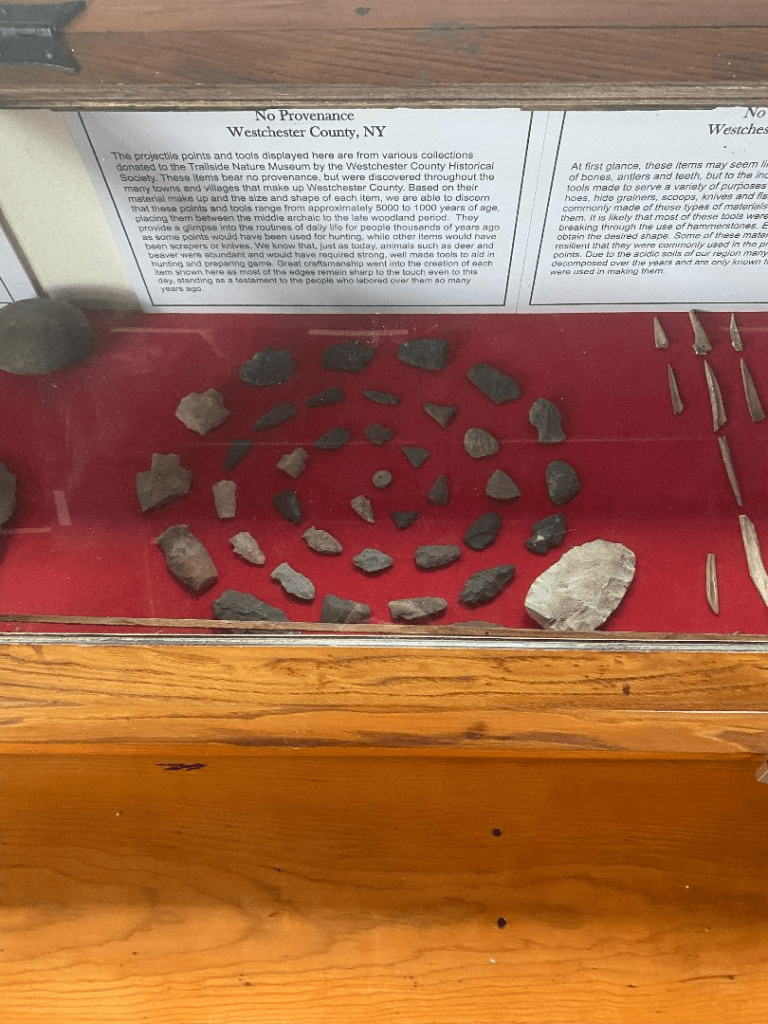
Projectile Points and Tools. Trailside Museum, Ward Pound Ridge Reservation.
References
- Kelley, T. (2004, May 2). In Their Footsteps. The New York Times. Retrieved March 5, 2023, from https://www.nytimes.com/2004/05/02/nyregion/in-their-footsteps.html
- Pound Ridge Massacre of Lenape Indians (New York). (n.d.). Retrieved March 5, 2023, from https://nativephilanthropy.candid.org/events/pound-ridge-massacre-of-lenape-indians-new-york/
- Virtual Jamestown. (n.d.). Retrieved March 5, 2023, from http://www.virtualjamestown.org/phatmass.html
- Wikimedia Foundation. (2022, December 26). Pound Ridge Massacre. Wikipedia. Retrieved March 5, 2023, from https://en.wikipedia.org/wiki/Pound_Ridge_massacre#:~:text=The%20Pound%20Ridge%20massacre%20was,of%20Pound%20Ridge%2C%20New%20York.
- Wounded knee: Massacre, Memorial & Battle – History. (n.d.). Retrieved March 5, 2023, from https://www.history.com/topics/native-american-history/wounded-knee
- YouTube. (2021, December 25). The Pound Ridge Massacre: A Dark Chapter from Early America. YouTube. Retrieved March 5, 2023, from https://www.youtube.com/watch?v=em847_OZqYg
 James Peacock's Website